Sara Ajnnak's Joiks Transport Audience to Sápmi
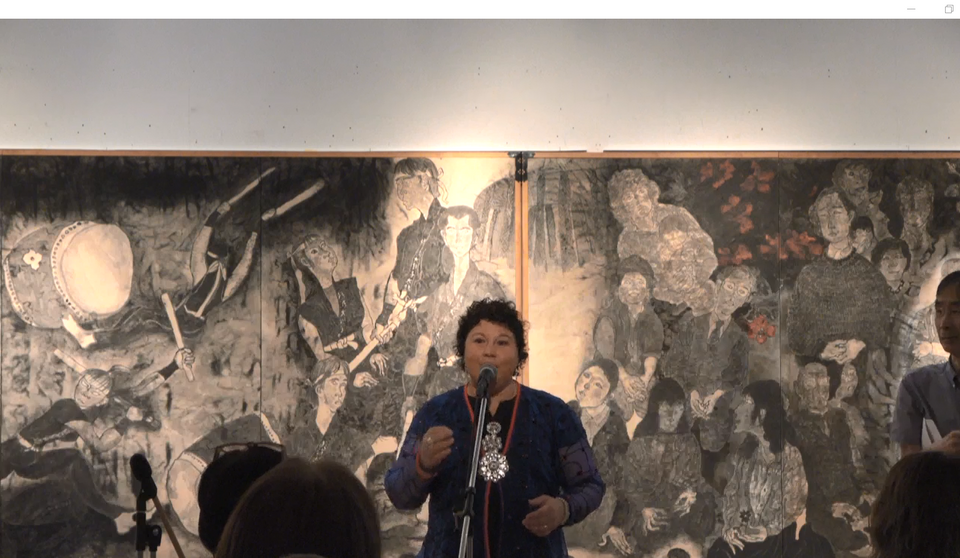
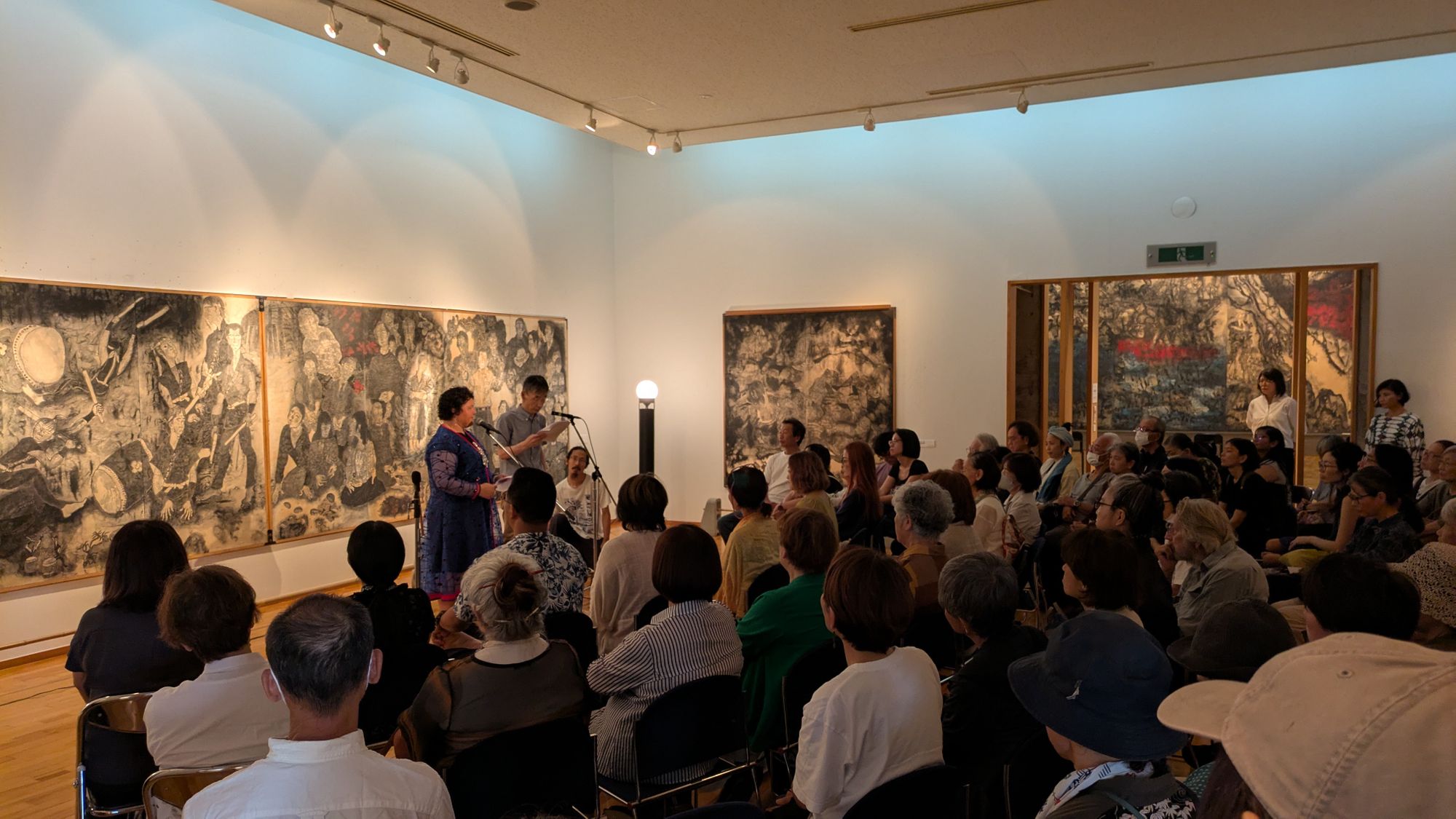
Sara Annak's clear voice echoed through the Sakima Art Museum in Ginowan, Okinawa, accompanied by the indigenous peoples depicted in the artworks of Anonie Frank Grahamsdaughter and Tomas Colbengtson, as well as the local people in the paintings of Mr and Mrs Maruki. The audience closed their eyes and listened attentively to Sara's joiks. Between periods of joiking, she read out the following English translation of her joiks, followed by my Japanese translation. The audience became immersed in Sápmi.
I begin my performance with Iädnamæ Vuälie – the joik of Mother Earth.
This joik is an invocation, a living song that connects us to the land beneath our feet and to the memory carried in the earth itself.
The joik tradition is one of the oldest musical expressions of the Sámi people. It is not only music – it is a way of speaking with nature, with ancestors, and with the spiritual world. When I joik Iädnamæ Vuälie, I call upon the presence of the Earth as a mother who nourishes, carries, and heals us.
From this opening, the performance flows into words and rhythms that reflect both sorrow and hope – a reminder that to feel is to live, and to live is to remember that we are not alone
I begin with Iädnamæ Vuälie – the joik of Mother Earth.
It is an invocation, a sound that connects us to the ground we stand on, to the roots of time, and to the living memory of the land.
Poem:
Okinawa
Your fertile lands, embraced by the sea.
Mahterahkka.
Warm sands — like the memory of touch.
Okinawa
You carry our shared tears in the ground.
Mahterahkka.
Yet you still shimmer,
yet you still embrace.
You love,
you give,
again and again.
Okinawa
We feel hunger.
We feel sorrow.
We feel fear.
We feel love.
We feel compassion.
We feel…
the pulse of the earth beneath our feet,
the trembling of memory,
the breath of those who came before us.
Mahterahkka
When the sorrow burns,
she heals us.
When the joy is loud,
she holds us.
Okinawa
I feel you,
I remember you,
we belong.
Mahterahkka,
you hold me,
you bind me,
you remind me.
that I belong.
Jojk Trees
From there, the performance moves into the peace of the forest, my interpretation of an old joik from my home area in Sápmi. The reason I can joik it today is because of the archival recordings that preserve the voices of those who came before us. Through those archives, I have heard her voice — a voice that reaches through time.
To let the melody of the forest breathe through my vuölie is to remember that we are connected — then, now, and in the times to come. The forest becomes a living presence, and the joik a way of listening to what still echoes within the land. It is a song of remembrance, of peace, and of belonging.
Jojk Krievieh
Krievieh- The power of the joik is to be
not outside the feeling,
but within it.
I do not joik about the reindeer.
I joik the reindeer
and the reindeer calf,
its fragile steps,
its first breath under the summer sky
NásaVuöllie– The Joik of Resistance
Humanity has one true task, to protect the Earth for the generations to come,
to ensure that our children, and all who follow will still have a place to be.
Yet we do not always understand what is truly good for us.
Exploitation threatens my life in Sápmi, more than anything else, except perhaps the changing climate. Mines, forestry, tourism and now, military training grounds cut into the body of the land.
Nása is the beginning of these exploitations in Sápmi. Four hundred years ago, a mine was created there. The water in Silbojavrie is still undrinkable. Now, a Chinese company wishes to open a new quartz mine on that same mountain. I travelled to Nása. I spoke with the mountain.
I made a promise to do everything within my power to protect it. We placed a great brass ring upon the mountain, a symbol of our covenant. That day, I received this joik and the mine has not opened since.
Geävrrie – The Drum Joik
I have felt the drum vibrate through my body. Its rhythm echoes deep within, awakening both longing and strength — a living pulse connecting body, soul, and memory.
My father is a skilled craftsman. It took him a lifetime to create this drum for me. For many years, it was as if generations of trauma had tied knots in his hands. Only when he finally released the fear of failure could he bring the drum to life.
To me, this drum is more than an instrument. It is a symbol of resistance, strength, and the courage to reclaim what was once taken. My father’s bravery vibrates beneath the drumskin, and he is with me every time I play.
In Sápmi, the drum once held great spiritual power. It was a sacred tool — a bridge between the human world and the spirit world. When the church understood its significance, the drums were confiscated. Some were sent to museums across Europe; most were burned.
Yet the heartbeat of the drum still lives.
I listen to its power
and let it flow through every beat.
Begäran Niejdgutje Vindens älskade lilla dotter
I end with Bieäggan Niejdgutje – Beloved Daughter of the Wind.
It is a tribute to all girls — a call to dance beneath the moonlight and follow the voice of their hearts. There are so many things that hold us back, so many fears that whisper you cannot. But we must not be afraid. We must open our hearts and follow our dreams, for the wind carries those who dare to move with it.
Poem
In the shadow of the trees’ crown,
in the shelter of the trunk’s strength.
A trembling surge from the source—
it flows, it keeps flowing—
carrying the wisdom of the ancient mother.
The ancient force, rooted in time,
streams through the soul,
pulsing, alive.
At the crossing point between worlds
I stand.
I behold the old wisdom’s power—
an omen,
a whisper from the vastness of time.
It leads me,
it carries me,
back to the strength of the root.*